


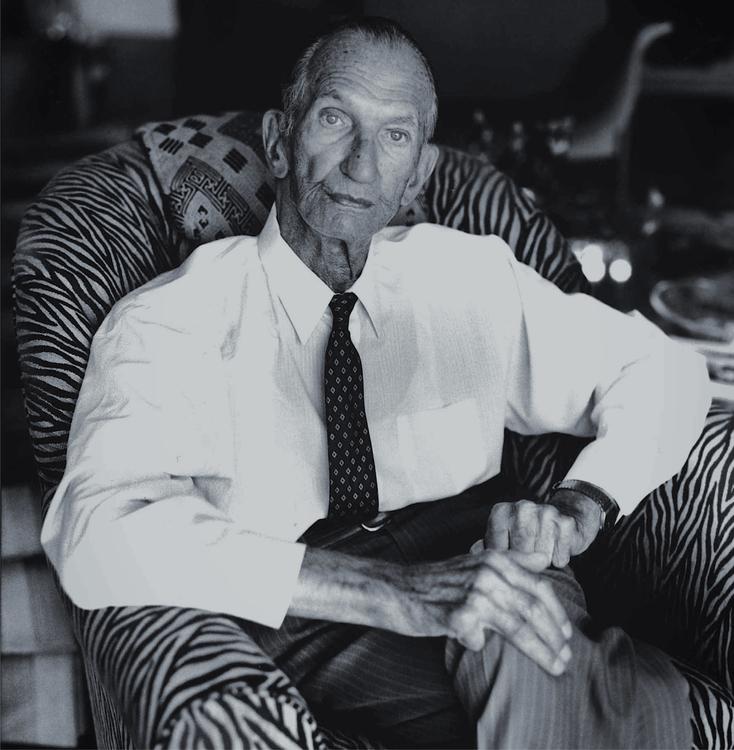
 Jan Karski in his later years (Photo: Carol Harrison)
On July 13, 2000, Jan Karski passed away. He was one of the most outstanding figures of the 20th century. “A man of upright character and a sense of justice,” said Elie Wiesel, the Nobel Peace Prize laureate, upon hearing of the death of Jan Karski, emissary of the Polish Underground State and witness to the Holocaust – and added “that thanks to him, we know that an individual, if they so desire, can influence the course of history. (…) Thanks to him, future generations will be able to believe in humanity.”
Although his valuable reports – delivered at the risk of his life from occupied Poland to the Polish government-in-exile in France and the UK, to Allied leaders in Britain and the US, and to creative and journalistic circles – did not bring the expected results, he left future generations, and us today, with a question about our individual responsibility when leaders fail.
The lasting impression he made on those he met is recounted by former presidents, ambassadors, journalists, scholars, and social activists in the book “Jan Karski in the Memories of Others”, the latest publication by the Jan Karski Educational Foundation, from which some of these quotes were drawn.
Twenty-five years ago, Jan Karski was mourned by Poles, Americans, Israelis, Christians, and Jews. A quarter of a century later, he is still remembered. “His universal values were always invaluable, and today the world needs him more than ever,” said Ewa Junczyk-Ziomecka, President of the Foundation.
A True Statesman
He placed the good of Poland above personal beliefs and interests. He inherited this from his home in Łódź, where he was raised with respect for Marshal Piłsudski – yet this did not prevent him from working with utmost dedication during the war with representatives of all political orientations. He considered the interests of the Polish state and people as paramount. “The priority for a statesman is the matter of the Polish state – its existence, survival, unity, integrity, and future… A true statesman doesn’t look to the next election, but to what will happen to the country, the state, and society over the next two generations, and acts in the long-term national interest, not for the next two or four years but for the next twenty. I believe Karski had that sense,” said Marian Turski.
“A forerunner in the fight for human rights,” said Marek Edelman, participant in the Warsaw Ghetto Uprising. “He stood up for the rights of the weak and defenseless – those without a voice, or whose voices were ignored. He defended the poor, the elderly, those with different skin colors or eye shapes,” said Kaya Mirecka-Ploss, a devoted friend of Jan Karski in Washington.
A Tolerant and Open-Minded Humanist, Emissary of Truth
A deeply religious Catholic who, during the war, witnessed horrific atrocities – the cruelty of Nazi Germany, the ruthlessness of Soviet Russia, the suffering and isolation of Poles, the genocide of Jews – but he never stopped believing in humanity. He courageously spoke the truth, regardless of circumstances. Open to other cultures and religions, he saw in them a rich source of inspiration for the development of modern civilization. “In a world that tries to divide us along the lines of religion, race, ethnicity, gender, or sexual orientation, he transcended those boundaries. He saw only people,” asserts David Harris, longtime director of the American Jewish Committee. “All of Karski’s life is a reminder that we are not islands, that we must understand and be sensitive to our neighbors, to those who think differently, to other communities,” says Aleksander Kwaśniewski.
A Pragmatic Idealist, a Courageous Man of Action
Proud of Poland’s regained independence after the partitions, he was ready to give his life for it. At the same time, he assessed our international position with realism – even cold pragmatism. In an interview with Michał Fajbusiewicz, he said: “Poles think their partisans defeated Hitler. Hitler lost the war because of thousands of ships, millions of tanks, thousands of planes. The Polish resistance was the largest in Europe, and yet it didn’t shorten the war by even two minutes.”
In a conversation with Maciej Wierzyński, he reminded us: “Poles must understand that Roosevelt was not the president of Poland, but of the United States. So, he did what was in the interest of the United States.” Karski had a sober view of the fact that nations, governments, and major politicians have their own interests – and that this must be understood.
Jan Karski united and inspired countless people around the world to stand up for values. He showed us what is worth fighting for and defined our tasks: defending freedom, protecting the weak, and respecting peace. “Many of these tasks remain unfinished to this day, as the world faces new threats,” says Stephen D. Mull, Karski’s former student and former U.S. Ambassador to Poland.
“The values Karski represented are the values of our civilization. And every generation must at some point not only stand up to defend them, but understand the essence of this challenge. Understand that one must have the courage to think a certain way – not just speak, but act, take risks,” believes Czesław Bielecki.
“What would Jan Karski say today?” wonders David Harris. “Stop talking about my past – it was what it was. Start talking about the present. Because if you don’t, the present will start to resemble the past (…).”
To sum up, Harris says: “We must not have just one Jan Karski, but a hundred, a thousand, a million who will stand up for what is right.”
Photo: Carol Harrison